

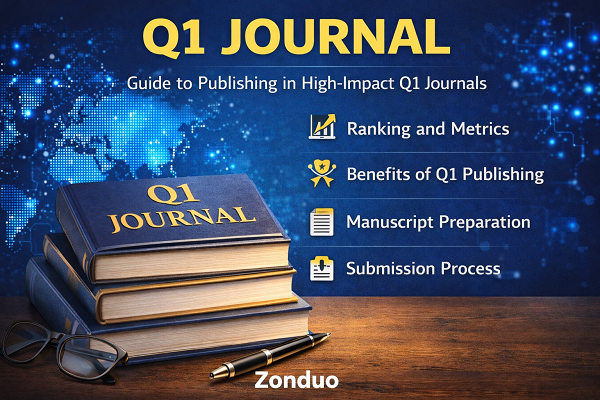
Publishing in a Q1 Journal is a major goal for researchers, scholars, and academic professionals worldwide. Q1 journals represent the top tier of academic publishing and are known for their high impact, strict peer-review process, and global recognition.
However, many researchers are unsure about what a Q1 journal truly means and how to publish their work successfully. At Zonduo, we help authors understand the publishing process clearly and prepare research that meets international standards. This guide explains everything you need to know about Q1 journals in a simple and structured way.
What Is a Q1 Journal?
A Q1 Journal refers to journals ranked in the first quartile of their subject category. These rankings are usually based on citation metrics provided by indexing databases such as Scopus and Web of Science.
Journals are divided into four quartiles: Q1, Q2, Q3, and Q4. Among these, Q1 journals fall in the top 25 percent, making them the most prestigious and influential publications in their field.
Why Q1 Journals Are Important for Researchers
Publishing in a Q1 Journal significantly improves academic credibility. Universities, funding agencies, and research institutions value Q1 publications because they reflect originality, quality, and impact.
Moreover, Q1 journal articles receive higher visibility and citations. This helps researchers build a strong academic profile and increases opportunities for promotions, grants, and collaborations. Zonduo always encourages authors to aim for quality over quantity when selecting journals.
How Q1 Journal Rankings Are Determined
Q1 rankings are calculated using citation-based indicators such as Impact Factor, CiteScore, and SCImago Journal Rank. These metrics measure how frequently articles published in a journal are cited by other researchers.
Each journal is compared within its specific subject category. Those that rank in the top quartile are classified as Q1 journals. Therefore, a journal may be Q1 in one subject and not in another.
Key Characteristics of a Q1 Journal
A Q1 Journal follows strict academic and ethical standards. These journals publish original research that contributes significantly to the field.
They also maintain a rigorous peer-review process, often involving multiple reviewers. In addition, Q1 journals have experienced editorial boards and clearly defined submission guidelines. At Zonduo, we help researchers align their manuscripts with these expectations.
Difference Between Q1, Q2, Q3, and Q4 Journals
Understanding journal quartiles helps in selecting the right publication outlet.
Q1 journals represent the highest quality and impact. Q2 journals are also reputable but slightly lower in ranking. Q3 and Q4 journals are considered less competitive but may still be suitable for early-stage research.
However, publishing in a Q1 journal carries the most academic value, especially for PhD scholars and faculty members.
How to Select the Right Q1 Journal
Choosing the correct Q1 Journal is crucial for successful publication. First, identify journals that match your research scope and subject area.
Next, review recent articles published in the journal to understand its focus and writing style. Also, check submission timelines and acceptance rates. Zonduo advises avoiding journals that promise guaranteed publication, as reputable Q1 journals never make such claims.
Preparing a Manuscript for Q1 Journal Submission
Manuscript preparation plays a vital role in acceptance. A well-structured paper with a clear research question increases success rates.
Your manuscript should follow the journal’s formatting guidelines strictly. This includes citation style, word limits, and section structure. Clear language, logical flow, and strong data analysis are equally important.
At Zonduo, we help researchers refine their manuscripts to meet Q1 journal standards without compromising originality.
Common Reasons for Rejection in Q1 Journals
Even strong research can be rejected if it fails to meet expectations. Common reasons include poor structure, weak methodology, and lack of novelty.
Language issues, improper references, and failure to follow journal guidelines also lead to rejection. Therefore, careful proofreading and compliance checks are essential before submission.
The Peer Review Process in Q1 Journals
The peer-review process in a Q1 Journal is thorough and time-consuming. After submission, the editor evaluates the paper for relevance and originality.
If the paper passes initial screening, it is sent to expert reviewers. Based on their feedback, the editor may accept, reject, or request revisions. Responding to reviewer comments professionally improves the chances of acceptance.
Ethical Standards in Q1 Publishing
Ethics play a critical role in Q1 journals. Plagiarism, data fabrication, and duplicate submissions are strictly prohibited.
Authors must ensure proper citations and transparency in data reporting. Zonduo emphasizes ethical writing practices to maintain research integrity and long-term academic reputation.
How Zonduo Supports Q1 Journal Publishing
At Zonduo, we provide structured guidance to researchers aiming for Q1 publications. Our support includes journal selection assistance, manuscript editing, formatting, and compliance checks.
We focus on improving clarity, coherence, and academic tone while preserving the author’s original contribution. With expert guidance, the Q1 publishing journey becomes more manageable and efficient.
Conclusion
Publishing in a Q1 Journal is a significant achievement that enhances academic recognition and career growth. Although the process is challenging, proper planning, quality research, and adherence to guidelines make success possible.
By understanding journal rankings, preparing strong manuscripts, and following ethical standards, researchers can increase their acceptance chances. With expert assistance from Zonduo, publishing in Q1 journals becomes a structured and achievable goal.