

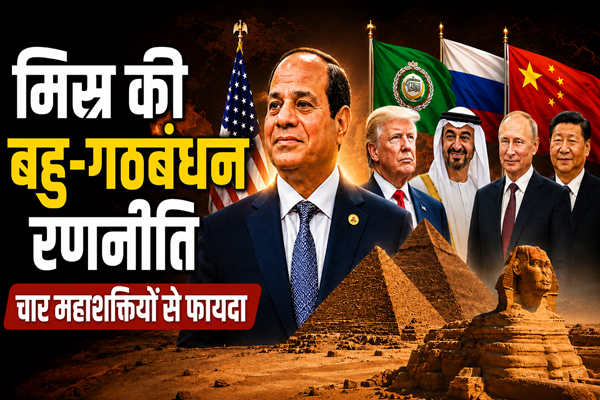
Egypt’s foreign policy emphasizes flexibility as global competition intensifies. The Egypt’s Multi-Alignment Strategy: Balancing USA, Russia and China reflects Cairo’s effort to maintain relationships with several key powers instead of relying on one external partner. Security needs, economic interests, regional diplomacy, and strategic autonomy all shape this approach.
What Multi-Alignment Means for Egypt
Multi-alignment does not necessarily mean treating every relationship equally. Egypt can cooperate with different countries according to interests. The Egypt’s Multi-Alignment Strategy: Balancing USA, Russia and China therefore involves selective cooperation across defense, investment, infrastructure, energy, technology, and diplomacy.
This approach gives Cairo room to pursue opportunities while avoiding excessive dependence on one power. A 2026 Princeton study describes Egypt’s hedging strategy as driven by risk reduction, economic benefits, and strategic autonomy, while noting that competing partnerships create dependencies.
Egypt’s Multi-Alignment Strategy: Balancing USA, Russia and China: US Ties
The United States remains an important security and diplomatic partner for Egypt. Washington has maintained longstanding defense and diplomatic ties with Cairo. The American connection provides military cooperation and a diplomatic channel.
At the same time, Cairo has sought greater flexibility as international politics change. The Egypt’s Multi-Alignment Strategy: Balancing USA, Russia and China allows Egypt to preserve cooperation with Washington while developing other major relationships. It reflects an effort to widen Egypt’s options.
Egypt’s Multi-Alignment Strategy: Balancing USA, Russia and China: Russia
Russia has become a significant element of Egypt’s external partnerships. Cooperation extends into energy, investment, trade, tourism, and infrastructure. The El Dabaa Nuclear Power Plant and Russian Industrial Zone in the Suez Canal Economic Zone are prominent examples.
In August 2026, Egyptian and Russian foreign ministers discussed strengthening economic, trade, and investment ties, while both sides highlighted continued work on El Dabaa. President Abdel Fattah El-Sisi and President Vladimir Putin also discussed bilateral projects during the BRICS summit in September.
These developments show why the Egypt’s Multi-Alignment Strategy: Balancing USA, Russia and China includes economic considerations alongside strategic relations.
Egypt’s Multi-Alignment Strategy: Balancing USA, Russia and China: China
China has become important through infrastructure, manufacturing, technology, investment, and diplomacy. Egypt and China established relations in 1956, and their partnership was elevated to a comprehensive strategic partnership in 2014.
Chinese President Xi Jinping visited Egypt on September 1 and 2, 2026, during the 70th anniversary year of diplomatic relations. The two countries agreed to deepen cooperation and coordinate more closely in areas including global governance, climate change, food security, energy, digital development, and BRICS.
Egypt’s Multi-Alignment Strategy and Technology
Technology is becoming a new test of Cairo’s balancing approach. China’s Huawei recently sought to expand its role in Egypt’s artificial intelligence sector, including a proposal involving government data centers and advanced AI chips. A Carnegie analysis reported that the proposal attracted attention in Washington, illustrating how technology choices can create strategic pressure between major powers.
For Egypt, technology decisions involve more than commercial value. They can affect data security, infrastructure standards, investment, and access to advanced systems. Consequently, the Egypt’s Multi-Alignment Strategy: Balancing USA, Russia and China extends into digital policy.
The Role of BRICS
Egypt’s membership in BRICS adds another dimension to its foreign policy. The group has expanded and includes Egypt among several Global South economies. At the 2026 BRICS summit in New Delhi, El-Sisi joined leaders including Vladimir Putin and Xi Jinping.
BRICS gives Egypt a platform for economic coordination and diplomacy beyond traditional Western institutions. Egypt can maintain Western relationships. This illustrates the Egypt’s Multi-Alignment Strategy: Balancing USA, Russia and China through overlapping channels.
A Separate Climate and Regional Issue
Nepal Floods and Climate Compensation: Role of India and China is a separate topic involving climate responsibility, disaster impacts, and South Asian regional cooperation. It should not be treated as part of Egypt’s multi-alignment policy because the countries, geography, and policy questions are different.
Benefits and Challenges of Balancing
The Egypt’s Multi-Alignment Strategy: Balancing USA, Russia and China can provide advantages. Diversified partnerships may create investment opportunities, broaden diplomatic choices, and reduce exposure to sudden changes in one relationship. Egypt can seek sector cooperation rather than one external model.
However, balancing major powers becomes difficult when their interests conflict. Technology restrictions, sanctions, regional wars, trade disputes, and security competition can pressure countries maintaining relationships with multiple sides. Cairo therefore must manage each partnership while protecting its priorities.
Egypt’s Multi-Alignment Strategy: Balancing USA, Russia and China: Autonomy
Strategic autonomy is central to understanding Egypt’s approach. The Egypt’s Multi-Alignment Strategy: Balancing USA, Russia and China is about preserving the ability to make decisions according to Egyptian interests.
Recent Chinese, Russian, and American engagements show that Cairo values different relationships for different purposes. Its challenge is to gain benefits without allowing any partnership to become an unavoidable constraint.
Conclusion
Egypt’s foreign policy shows how middle powers can navigate an increasingly competitive international system. The Egypt’s Multi-Alignment Strategy: Balancing USA, Russia and China combines security cooperation, economic diversification, technology interests, and multilateral diplomacy. Relations with Washington remain significant, while Moscow supports major energy and industrial projects, and Beijing offers expanding opportunities in infrastructure, technology, and trade.
For Infosagar readers, the Egypt’s Multi-Alignment Strategy: Balancing USA, Russia and China offers a case study of diplomatic flexibility. Its future will depend on how effectively Cairo manages external pressures while preserving room for independent decisions.